 Geodly
Europe
Switzerland
Switzerland is a small, landlocked country in the heart of Western Europe, bordered by Germany, France, Italy, Austria and Liechtenstein. Its roots go back to 1291, when three Alpine communities formed an alliance, and the modern federal state was created in 1848. The country is divided into 26 cantons, which keep a large degree of self-government.
Switzerland has four national languages: German, French, Italian and Romansh. Swiss citizens vote several times a year in national referendums, a system of direct democracy that lets them change the constitution or overturn laws. The country is known for its long tradition of neutrality, for banking, for watches and chocolate, and as the seat of many international organisations in Geneva. Bern is the seat of the federal government, although the constitution calls it the federal city rather than the capital.
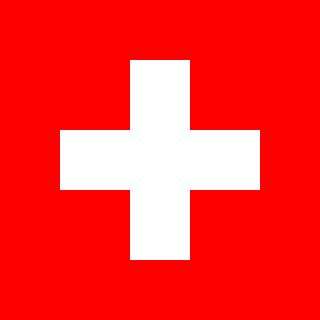
The flag of Switzerland
The flag is square and red, with a white cross in the centre whose arms are of equal length and do not reach the edges.
The white cross on red goes back to the banner of the canton of Schwyz, which also gave the country its name, and it was used by Swiss soldiers from the Middle Ages. It became the official national flag in the 1800s. Switzerland and Vatican City are the only countries with square national flags. The emblem of the Red Cross, founded in Geneva in 1863, reverses the Swiss colours in honour of the country.
Landscape and geography
The Alps cover more than half of Switzerland and include dozens of peaks over 4,000 metres. The highest is the Dufourspitze in the Monte Rosa massif, at 4,634 metres, while the Matterhorn above Zermatt is the most famous. North of the Alps lies the Swiss Plateau, where most people live, and the Jura Mountains form the north-western edge of the country.
Switzerland is often called the water tower of Europe. The Rhine and the Rhône both rise in the Swiss Alps, and the country has large lakes such as Lake Geneva and Lake Constance, which it shares with its neighbours.
Did you know?
- The Gotthard Base Tunnel, opened in 2016, is the longest railway tunnel in the world at about 57 kilometres.
- Switzerland is not a member of the European Union, but it is part of the Schengen Area.
- Women gained the right to vote in Swiss federal elections in 1971.
- The official name, Confoederatio Helvetica, is Latin, which is why Swiss cars carry the code CH.
Key facts
- Capital
- Bern
- Continent
- Europe
- Population
- About 8.8 million
- Land neighbours
- 5
- Coast
- Landlocked
- European Union
- Not a member
- NATO
- Not a member
Land neighbours
World rankings
Geo Sort asks you to place countries by rank. A lower number means a higher place in that category.
| Land Area | #132 |
|---|---|
| Coastline | #193 |
| FIFA Ranking (M) | #19 |
| Military Strength | #44 |
| Avg Annual Temperature | #159 |
| UNESCO Sites | #26 |
| Population Density | #57 |
| Highest Point | #9 |
Practise Switzerland on Geodly
- Flag Drawing: The flag of Switzerland is in the Easy set. Draw it from memory and compare your drawing with the real design.
- Border Clash: Draw the border between Switzerland and Italy on a blank map.
- Geo Click: Find Switzerland on the map, or locate its capital, Bern, in the capital modes.
- Geo Chain: Link countries through shared land borders. Knowing the 5 neighbours of Switzerland gives you more routes.
- Geo Sort: Place Switzerland in the category where its world rank is strongest.
- Terra Tac Toe: Use Switzerland as an answer when its facts fit both the row and the column of a square.
Sources: Encyclopaedia Britannica: Switzerland · CIA World Factbook: Switzerland