 Geodly
Europe
Germany
Germany lies in the centre of Europe, stretching from the North Sea and the Baltic Sea in the north to the Alps in the south. It has nine neighbouring countries, one of the highest numbers in Europe. With about 84 million people, it is the most populous country in the European Union and has the EU’s largest economy. The capital and largest city is Berlin.
For much of its history Germany was a patchwork of kingdoms, duchies and free cities, and it was first united as a single state in 1871. After the Second World War the country was divided into West Germany and East Germany, and Berlin was split by the Berlin Wall from 1961. The wall fell on 9 November 1989, and Germany was reunified on 3 October 1990. Today it is a federal republic of 16 states, each with its own government.
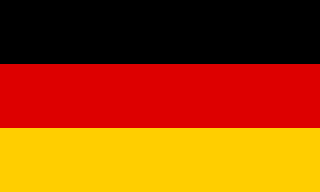
The flag of Germany
The flag has three horizontal stripes of equal height: black at the top, red in the middle and gold at the bottom.
The colours go back to the wars against Napoleon in the early 1800s, when volunteer soldiers of the Lützow Free Corps wore black uniforms with red trim and gold buttons. Black, red and gold became the colours of the movement for a united and democratic Germany in the revolution of 1848. The flag was used by the Weimar Republic after 1919 and was adopted again by West Germany in 1949. East Germany used the same stripes with its emblem added, and the plain flag became the flag of reunified Germany in 1990.
Landscape and geography
The north of Germany is part of the low, flat North European Plain, with sandy coasts, marshes and islands such as Rügen and Sylt. The middle of the country is a belt of forested uplands, including the Harz and the Black Forest. In the far south, Bavaria rises into the Alps, where the Zugspitze, at 2,962 metres, is the highest mountain in Germany.
Several of Europe’s great rivers flow through Germany. The Rhine runs past castles and vineyards on its way to the North Sea, the Elbe flows through Dresden and Hamburg, and the Danube begins in the Black Forest before heading east towards the Black Sea.
Did you know?
- Johannes Gutenberg developed printing with movable metal type in Mainz around 1450.
- Many stretches of the German Autobahn have no general speed limit, only a recommended speed.
- Oktoberfest in Munich began in 1810 as the celebration of a royal wedding.
- Neuschwanstein Castle in Bavaria, built for King Ludwig II, is one of the most photographed buildings in Europe.
Key facts
- Capital
- Berlin
- Continent
- Europe
- Population
- About 84 million
- Land neighbours
- 9
- Coast
- Has a coastline
- European Union
- Member
- NATO
- Member
- Language in GeoLingo
- German
Land neighbours
Germany in numbers
| Population | 84,358,845 people |
|---|---|
| Land area | 348,560 km² |
| Population density | 240 people/km² |
| Total GDP | $4,456,000,000,000 |
| GDP per capita | $52,800 |
| Life expectancy | 81 years |
| Unemployment rate | 3.1% |
| Coastline | 2,389 km |
| Forest coverage | 32.7% |
| Human Development Index | 0.942 |
| UNESCO World Heritage sites | 52 sites |
| Airports | 539 airports |
These are the figures used in GeoDecide. They are rounded and can lag behind the latest official statistics.
World rankings
Geo Sort asks you to place countries by rank. A lower number means a higher place in that category.
| Land Area | #63 |
|---|---|
| Coastline | #52 |
| FIFA Ranking (M) | #17 |
| Military Strength | #19 |
| Avg Annual Temperature | #146 |
| UNESCO Sites | #3 |
| Population Density | #50 |
| Highest Point | #59 |
Say it in German
GeoLingo shows these four phrases and asks which country they belong to.
- Hello
- Hallo
- Thank you
- Danke
- Yes
- Ja
- Goodbye
- Tschüss
Practise Germany on Geodly
- Flag Drawing: The flag of Germany is in the Easy set. Draw it from memory and compare your drawing with the real design.
- Border Clash: Draw the border between Germany and France on a blank map.
- Border Clash: Draw the border between Germany and Austria on a blank map.
- Border Clash: Draw the border between Germany and the Czech Republic on a blank map.
- Border Clash: Draw the border between Germany and Poland on a blank map.
- Geo Click: Find Germany on the map, or locate its capital, Berlin, in the capital modes.
- Geo Chain: Link countries through shared land borders. Knowing the 9 neighbours of Germany gives you more routes.
- GeoDecide: Compare Germany with other countries on the statistics listed above.
- Geo Sort: Place Germany in the category where its world rank is strongest.
- GeoLingo: Recognise German from four short phrases and match it to Germany.
- Terra Tac Toe: Use Germany as an answer when its facts fit both the row and the column of a square.
Sources: Encyclopaedia Britannica: Germany · CIA World Factbook: Germany