 Geodly
Europe
Denmark
Denmark is the southernmost of the Nordic countries. It is made up of the Jutland peninsula, which joins the European mainland, and hundreds of islands, the largest of which are Zealand and Funen. Copenhagen, the capital, lies on Zealand, facing Sweden across the narrow Øresund strait. About six million people live in Denmark, and its only land border is a short one with Germany.
The Danish monarchy is one of the oldest in the world, with a line of kings going back more than a thousand years to the Viking Age. Denmark has been a constitutional monarchy since 1849. The Kingdom of Denmark also includes Greenland and the Faroe Islands, which govern most of their own affairs. Denmark joined NATO as a founding member in 1949 and the European Economic Community in 1973, but it has kept its own currency, the krone.
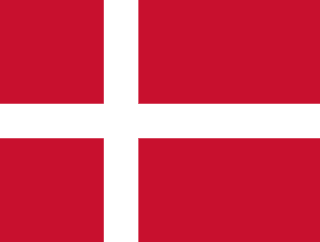
The flag of Denmark
The flag, called the Dannebrog, is red with a white cross. The cross is set towards the flagpole, with the longer arm stretching out to the fly.
According to legend, the flag fell from the sky during a battle at Lyndanisse, in present-day Estonia, in 1219, and helped the Danes win. Whatever its true origin, the design was in use by the 1300s, and Denmark’s flag is often described as the oldest national flag in continuous use. Its off-centre cross became the model for the other Nordic flags.
Landscape and geography
Denmark is one of the flattest countries in Europe. Its highest natural point is only about 170 metres above sea level, and no place in the country is more than about 50 kilometres from the sea. The landscape is mostly gently rolling farmland, shaped by glaciers in the last Ice Age, with sand dunes and lagoons along the west coast of Jutland.
Being surrounded by water, Denmark relies on bridges and tunnels. The Great Belt Bridge links Zealand and Funen, and the Øresund Bridge, opened in 2000, connects Copenhagen with Malmö in Sweden. The steady winds off the North Sea have made Denmark a pioneer in wind power, which supplies a large share of its electricity.
Did you know?
- LEGO was founded in Billund in Jutland. Its name comes from the Danish words leg godt, meaning play well.
- Tivoli Gardens in Copenhagen opened in 1843 and is one of the oldest amusement parks in the world.
- Copenhagen is known for cycling, and more people there commute by bicycle than by car.
- Hans Christian Andersen, author of The Little Mermaid and The Ugly Duckling, was born in Odense on Funen.
Key facts
- Capital
- Copenhagen
- Continent
- Europe
- Population
- About 5.9 million
- Land neighbours
- 1
- Coast
- Has a coastline
- European Union
- Member
- NATO
- Member
- Language in GeoLingo
- Danish
Land neighbours
Denmark in numbers
| Population | 5,903,037 people |
|---|---|
| Land area | 42,434 km² |
| Population density | 139.1 people/km² |
| Total GDP | $404,199,000,000 |
| GDP per capita | $68,470 |
| Life expectancy | 81.5 years |
| Unemployment rate | 4.8% |
| Coastline | 7,314 km |
| Forest coverage | 15.7% |
| Human Development Index | 0.948 |
| UNESCO World Heritage sites | 10 sites |
| Airports | 80 airports |
These are the figures used in GeoDecide. They are rounded and can lag behind the latest official statistics.
Say it in Danish
GeoLingo shows these four phrases and asks which country they belong to.
- Hello
- Hej
- Thank you
- Tak
- Yes
- Ja
- Goodbye
- Hej hej
Practise Denmark on Geodly
- Flag Drawing: The flag of Denmark is in the Easy set. Draw it from memory and compare your drawing with the real design.
- Geo Click: Find Denmark on the map, or locate its capital, Copenhagen, in the capital modes.
- Geo Chain: Link countries through shared land borders. Knowing the neighbour of Denmark gives you more routes.
- GeoDecide: Compare Denmark with other countries on the statistics listed above.
- GeoLingo: Recognise Danish from four short phrases and match it to Denmark.
- Terra Tac Toe: Use Denmark as an answer when its facts fit both the row and the column of a square.
Sources: Encyclopaedia Britannica: Denmark · CIA World Factbook: Denmark