 Geodly
Europe
Italy
Italy is a long, boot-shaped peninsula reaching into the Mediterranean Sea from southern Europe, together with the large islands of Sicily and Sardinia and many smaller ones. Two independent microstates, San Marino and Vatican City, lie entirely within Italian territory. About 59 million people live in Italy, and its capital, Rome, was once the heart of the Roman Empire.
After the fall of Rome, the peninsula was divided for centuries into city-states, kingdoms and papal lands. It was a centre of the Renaissance, and cities such as Florence, Venice and Rome are filled with its art and architecture. Italy was unified as a kingdom in 1861, with Rome becoming the capital in 1871, and it became a republic after a referendum in 1946. Italy was one of the six founding members of what is now the European Union.
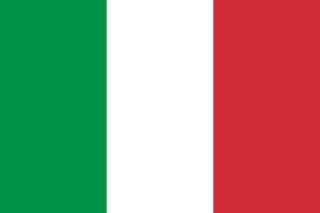
The flag of Italy
The flag has three vertical stripes of equal width: green by the flagpole, white in the middle and red on the outside. Italians call it il Tricolore.
The design was inspired by the French flag, which arrived with Napoleon’s armies in the 1790s. A green, white and red tricolour was first adopted as a national flag by the Cispadane Republic in 1797, and 7 January is still marked as Flag Day. The colours are popularly said to stand for the green plains, the snowy Alps and the blood of those who fought for Italian independence. The plain tricolour became the flag of the republic in 1948.
Landscape and geography
The Alps form Italy’s northern border, and the Apennine Mountains run down the length of the peninsula like a spine. Between the Alps and the Apennines lies the Po Valley, the country’s largest plain and its main farming and industrial region, crossed by the Po, Italy’s longest river. The great lakes of the north, such as Garda, Como and Maggiore, were carved by glaciers.
Southern Italy is volcanically active. Mount Etna on Sicily is one of the most active volcanoes in the world, Stromboli has been erupting almost continuously for centuries, and Vesuvius looms over the Bay of Naples.
Did you know?
- The eruption of Vesuvius in AD 79 buried the Roman towns of Pompeii and Herculaneum, preserving them for archaeologists.
- Venice is built on more than a hundred small islands in a lagoon, linked by canals and around 400 bridges.
- Italy has more UNESCO World Heritage sites than almost any other country.
- Pizza Margherita, with tomato, mozzarella and basil, is traditionally said to be named after Queen Margherita, who visited Naples in 1889.
Key facts
- Capital
- Rome
- Continent
- Europe
- Population
- About 59 million
- Land neighbours
- 6
- Coast
- Has a coastline
- European Union
- Member
- NATO
- Member
- Language in GeoLingo
- Italian
Land neighbours
- Austria
- France
- San Marino
- Slovenia
- Switzerland
- Vatican City
World rankings
Geo Sort asks you to place countries by rank. A lower number means a higher place in that category.
| Land Area | #72 |
|---|---|
| Coastline | #15 |
| FIFA Ranking (M) | #9 |
| Military Strength | #10 |
| Avg Annual Temperature | #125 |
| UNESCO Sites | #1 |
| Population Density | #59 |
| Highest Point | #12 |
Say it in Italian
GeoLingo shows these four phrases and asks which country they belong to.
- Hello
- Ciao
- Thank you
- Grazie
- Yes
- Sì
- Goodbye
- Arrivederci
Practise Italy on Geodly
- Flag Drawing: The flag of Italy is in the Easy set. Draw it from memory and compare your drawing with the real design.
- Border Clash: Draw the border between Italy and Switzerland on a blank map.
- Geo Click: Find Italy on the map, or locate its capital, Rome, in the capital modes.
- Geo Chain: Link countries through shared land borders. Knowing the 6 neighbours of Italy gives you more routes.
- Geo Sort: Place Italy in the category where its world rank is strongest.
- GeoLingo: Recognise Italian from four short phrases and match it to Italy.
- Terra Tac Toe: Use Italy as an answer when its facts fit both the row and the column of a square.
Sources: Encyclopaedia Britannica: Italy · CIA World Factbook: Italy