 Geodly
Europe
Spain
Spain covers most of the Iberian Peninsula in south-western Europe, sharing it with Portugal, and is separated from France by the Pyrenees. It also includes the Balearic Islands in the Mediterranean, the Canary Islands off the coast of Africa, and the cities of Ceuta and Melilla on the North African coast. With about 49 million people, it is one of the largest countries in the European Union, and its capital, Madrid, lies close to the geographic centre of the peninsula.
Over the centuries Iberia was shaped by Romans, Visigoths and the Muslim rulers of al-Andalus, whose legacy can be seen in buildings such as the Alhambra in Granada. In the 1500s Spain built one of the largest empires in history, which is why Spanish is now spoken by hundreds of millions of people around the world. After the dictatorship of Francisco Franco, Spain became a parliamentary democracy with a constitutional monarchy under the constitution of 1978.
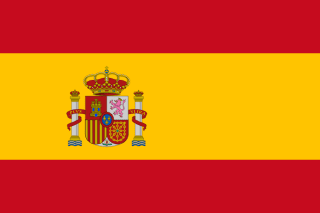
The flag of Spain
The flag has three horizontal stripes, red, yellow and red. The yellow stripe is twice as tall as each red one and carries the Spanish coat of arms, set towards the flagpole.
The red and yellow design was chosen by King Charles III in 1785 for Spanish warships, because the earlier white naval flags were hard to tell apart from those of other countries at sea. The colours come from the old kingdoms of Castile and Aragon. The current coat of arms was added in 1981, after the return to democracy.
Landscape and geography
Spain is one of the most mountainous countries in Europe. Much of its interior is the Meseta, a high central plateau with hot summers and cold winters, ringed by mountain ranges. The Sierra Nevada in Andalusia holds the highest peaks on the mainland, while the highest point in Spain is Teide, a volcano on Tenerife in the Canary Islands, at about 3,700 metres.
The north coast along the Bay of Biscay is green and rainy, while the south and east have a sunny Mediterranean climate that draws millions of visitors each year. The Ebro, the Tagus and the Guadalquivir are among its main rivers.
Did you know?
- Besides Spanish, several regional languages are official in parts of Spain, including Catalan, Galician and Basque.
- Work on the Sagrada Família basilica in Barcelona began in 1882, and the church designed by Antoni Gaudí is still being completed.
- The Canary Islands are volcanic, and La Palma saw a major eruption in 2021.
- Spain is the world’s largest producer of olive oil.
Key facts
- Capital
- Madrid
- Continent
- Europe
- Population
- About 48 million
- Land neighbours
- 5
- Coast
- Has a coastline
- European Union
- Member
- NATO
- Member
- Language in GeoLingo
- Spanish
Land neighbours
World rankings
Geo Sort asks you to place countries by rank. A lower number means a higher place in that category.
| Land Area | #52 |
|---|---|
| Coastline | #28 |
| FIFA Ranking (M) | #8 |
| Military Strength | #20 |
| Avg Annual Temperature | #121 |
| UNESCO Sites | #9 |
| Population Density | #104 |
| Highest Point | #38 |
Say it in Spanish
GeoLingo shows these four phrases and asks which country they belong to.
- Hello
- Hola
- Thank you
- Gracias
- Yes
- Sí
- Goodbye
- Adiós
Practise Spain on Geodly
- Flag Drawing: The flag of Spain is in the Easy set. Draw it from memory and compare your drawing with the real design.
- Border Clash: Draw the border between Spain and France on a blank map.
- Border Clash: Draw the border between Spain and Portugal on a blank map.
- Geo Click: Find Spain on the map, or locate its capital, Madrid, in the capital modes.
- Geo Chain: Link countries through shared land borders. Knowing the 5 neighbours of Spain gives you more routes.
- Geo Sort: Place Spain in the category where its world rank is strongest.
- GeoLingo: Recognise Spanish from four short phrases and match it to Spain.
- Terra Tac Toe: Use Spain as an answer when its facts fit both the row and the column of a square.
Sources: Encyclopaedia Britannica: Spain · CIA World Factbook: Spain