 Geodly
Africa
South Africa
South Africa lies at the southern tip of the African continent, with the Atlantic Ocean to the west and the Indian Ocean to the east. About 63 million people live there. It borders Namibia, Botswana, Zimbabwe, Mozambique and Eswatini, and it completely surrounds the small kingdom of Lesotho. South Africa has twelve official languages, including Zulu, Xhosa, Afrikaans, English and South African Sign Language.
For most of the twentieth century South Africa was ruled under apartheid, a system of racial segregation that kept political power in the hands of the white minority. After years of resistance and international pressure, the country held its first democratic elections in April 1994, and Nelson Mandela became its first Black president. The diversity of its peoples and cultures led to the nickname the Rainbow Nation.
South Africa has three capitals: Pretoria (executive), Cape Town (legislative) and Bloemfontein (judicial).
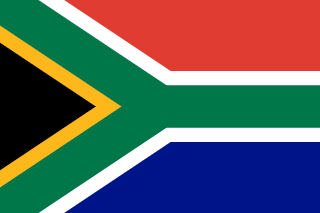
The flag of South Africa
The flag has a green band shaped like a sideways Y, edged in white and gold, which joins a red stripe at the top and a blue stripe at the bottom, with a black triangle by the flagpole.
The flag was designed by Frederick Brownell and first flown on 27 April 1994, the day of the first democratic election. It has six colours, which makes it one of the most colourful national flags. Officially the colours carry no single meaning, but the Y shape is widely seen as different paths coming together and continuing as one, a symbol of unity after apartheid.
Landscape and geography
Much of South Africa is a high interior plateau, the Highveld, edged by a steep slope called the Great Escarpment. Its highest and most dramatic section is the Drakensberg, which rises above 3,000 metres along the border with Lesotho. The west is dry, with the semi-desert Karoo and the Namaqualand coast, while the east is wetter and greener.
At the south-western tip, Cape Town sits beneath the flat-topped Table Mountain, near the Cape of Good Hope. The Cape Floral Region around it is one of the richest areas of plant life on Earth. In the north-east, Kruger National Park is one of Africa’s largest wildlife reserves.
Did you know?
- South Africa has three capital cities: Pretoria, Cape Town and Bloemfontein, each housing a different branch of government.
- The Cradle of Humankind near Johannesburg has produced some of the most important fossils of early human ancestors.
- The world’s first human heart transplant was carried out in Cape Town in 1967.
- South Africa is the world’s largest producer of platinum.
Key facts
- Capital
- Pretoria
- Continent
- Africa
- Population
- About 60 million
- Land neighbours
- 6
- Coast
- Has a coastline
- European Union
- Not a member
- NATO
- Not a member
Land neighbours
World rankings
Geo Sort asks you to place countries by rank. A lower number means a higher place in that category.
| Land Area | #25 |
|---|---|
| Coastline | #38 |
| FIFA Ranking (M) | #58 |
| Military Strength | #33 |
| Avg Annual Temperature | #92 |
| UNESCO Sites | #22 |
| Population Density | #132 |
| Highest Point | #47 |
Practise South Africa on Geodly
- Flag Drawing: The flag of South Africa is in the Easy set. Draw it from memory and compare your drawing with the real design.
- Geo Click: Find South Africa on the map, or locate its capital, Pretoria, in the capital modes.
- Geo Chain: Link countries through shared land borders. Knowing the 6 neighbours of South Africa gives you more routes.
- Geo Sort: Place South Africa in the category where its world rank is strongest.
- Terra Tac Toe: Use South Africa as an answer when its facts fit both the row and the column of a square.
Sources: Encyclopaedia Britannica: South Africa · CIA World Factbook: South Africa