 Geodly
Europe
Iceland
Iceland is an island in the North Atlantic Ocean, just south of the Arctic Circle. It has fewer than 400,000 people, most of whom live in and around Reykjavík, the northernmost capital of a sovereign country. The island was settled mainly by Norse people from the late 800s, and the Old Norse they spoke developed into modern Icelandic, which has changed so little that Icelanders can still read the medieval sagas.
Iceland’s parliament, the Althing, was founded in 930 and is one of the oldest parliaments in the world. The country was ruled by Norway and later Denmark for centuries, and became a fully independent republic on 17 June 1944. Iceland is a founding member of NATO but has no standing army. It is not a member of the European Union, but it belongs to the European Economic Area and the Schengen Area.
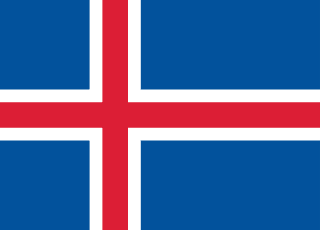
The flag of Iceland
The flag is blue with a red Nordic cross outlined in white, placed closer to the flagpole.
The design was approved in the early 1900s and became the flag of the independent republic in 1944. The colours are usually explained through the island’s landscape: blue for the mountains and the sky, white for the ice and snow, and red for the fire of its volcanoes. Its cross matches the other Nordic flags and reflects Iceland’s ties with Scandinavia.
Landscape and geography
Iceland sits on the Mid-Atlantic Ridge, where the North American and Eurasian tectonic plates are slowly pulling apart. This makes it one of the most volcanically active places on Earth, with around thirty active volcanic systems, as well as hot springs, geysers and lava fields. Large ice caps cover about a tenth of the island. The biggest, Vatnajökull, is one of the largest ice caps in Europe, and the country’s highest peak, Hvannadalshnúkur, rises from its edge.
The interior is a high, mostly uninhabited plateau of lava, sand and glaciers, so towns and farms cling to the coast. The ring road that circles the island is about 1,300 kilometres long.
Did you know?
- The English word geyser comes from Geysir, a hot spring in south-west Iceland.
- Geothermal energy heats around nine in ten homes in Iceland.
- Most Icelanders do not have family names. Their surname is formed from a parent’s first name, such as Jónsdóttir, Jón’s daughter.
- The eruption of Eyjafjallajökull in 2010 sent an ash cloud over Europe that grounded flights for days.
Key facts
- Capital
- Reykjavik
- Continent
- Europe
- Population
- About 388,000
- Land neighbours
- None
- Coast
- Island country
- European Union
- Not a member
- NATO
- Member
- Language in GeoLingo
- Icelandic
Iceland in numbers
| Population | 387,758 people |
|---|---|
| Land area | 100,250 km² |
| Population density | 3.8 people/km² |
| Total GDP | $31,000,000,000 |
| GDP per capita | $78,800 |
| Life expectancy | 83 years |
| Unemployment rate | 3.4% |
| Coastline | 4,970 km |
| Forest coverage | 0.5% |
| Human Development Index | 0.959 |
| UNESCO World Heritage sites | 3 sites |
| Airports | 96 airports |
These are the figures used in GeoDecide. They are rounded and can lag behind the latest official statistics.
Say it in Icelandic
GeoLingo shows these four phrases and asks which country they belong to.
- Hello
- Hæ
- Thank you
- Takk
- Yes
- Já
- Goodbye
- Bless
Practise Iceland on Geodly
- Flag Drawing: The flag of Iceland is in the Easy set. Draw it from memory and compare your drawing with the real design.
- GeoDecide: Compare Iceland with other countries on the statistics listed above.
- GeoLingo: Recognise Icelandic from four short phrases and match it to Iceland.
- Terra Tac Toe: Use Iceland as an answer when its facts fit both the row and the column of a square.
Sources: Encyclopaedia Britannica: Iceland · CIA World Factbook: Iceland