 Geodly
Asia
Azerbaijan
Azerbaijan sits where Eastern Europe meets Western Asia, between the Caucasus Mountains and the western shore of the Caspian Sea. It borders Russia, Georgia, Armenia and Iran, and its exclave of Nakhchivan, separated from the rest of the country by Armenian territory, also touches Turkey. Because it straddles that boundary, Azerbaijan is often counted as a transcontinental country.
In 1918 the Azerbaijan Democratic Republic became one of the first secular republics in the Muslim world, but it was absorbed into the Soviet Union in 1920. Azerbaijan regained its independence in 1991. Oil and natural gas from the Caspian have shaped the country for more than a century, and the capital, Baku, grew from a small port into a large modern city on the back of them.
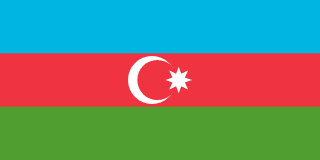
The flag of Azerbaijan
The flag has three horizontal stripes of blue, red and green, with a white crescent and a white eight-pointed star in the centre of the red stripe.
The flag was first adopted in 1918 and brought back in 1991. Blue is usually explained as a reference to the country’s Turkic heritage, red as progress and modernisation, and green as Islam. The crescent and star are a common symbol in the region. There are several explanations for the eight points of the star; one links them to the eight letters of the word Azerbaijan in the old Arabic script.
Landscape and geography
The Greater Caucasus range forms the northern edge of the country, and the Lesser Caucasus rises in the west. Between them, the Kura and Aras rivers water a wide lowland that runs down to the Caspian. The Caspian is the largest enclosed body of water on Earth and its surface lies below sea level, so Baku, at about 28 metres below sea level, is the lowest-lying national capital in the world.
Azerbaijan has a remarkable number of mud volcanoes, small cones that bubble with cold mud and gas. Hundreds of them are found on land and offshore, many on the Absheron Peninsula around Baku and in Gobustan, which is also known for its prehistoric rock carvings.
Did you know?
- Azerbaijan is often called the Land of Fire. At Yanar Dag near Baku, natural gas seeping from a hillside has burned continuously for decades.
- Baku’s oil boom in the late 1800s drew investors such as the Nobel brothers, and the region once produced about half of the world’s oil.
- The walled Old City of Baku, with the Maiden Tower and the Palace of the Shirvanshahs, is a UNESCO World Heritage site.
- The country has many climate zones in a small area, from semi-desert along the coast to snowy peaks over 4,000 metres in the Caucasus.
Key facts
- Capital
- Baku
- Continent
- Asia
- Population
- About 10 million
- Land neighbours
- 5
Land neighbours
Azerbaijan in numbers
| Population | 10,141,756 people |
|---|---|
| Land area | 82,629 km² |
| Population density | 122.7 people/km² |
| Total GDP | $72,356,000,000 |
| GDP per capita | $7,135 |
| Life expectancy | 69.4 years |
| Unemployment rate | 5.6% |
| Coastline | 713 km |
| Forest coverage | 12% |
| Human Development Index | 0.745 |
| UNESCO World Heritage sites | 4 sites |
| Airports | 37 airports |
These are the figures used in GeoDecide. They are rounded and can lag behind the latest official statistics.
Practise Azerbaijan on Geodly
- Flag Drawing: The flag of Azerbaijan is in the Hard set. Draw it from memory and compare your drawing with the real design.
- Geo Chain: Link countries through shared land borders. Knowing the 5 neighbours of Azerbaijan gives you more routes.
- GeoDecide: Compare Azerbaijan with other countries on the statistics listed above.
Sources: Encyclopaedia Britannica: Azerbaijan · CIA World Factbook: Azerbaijan